Key Takeaways
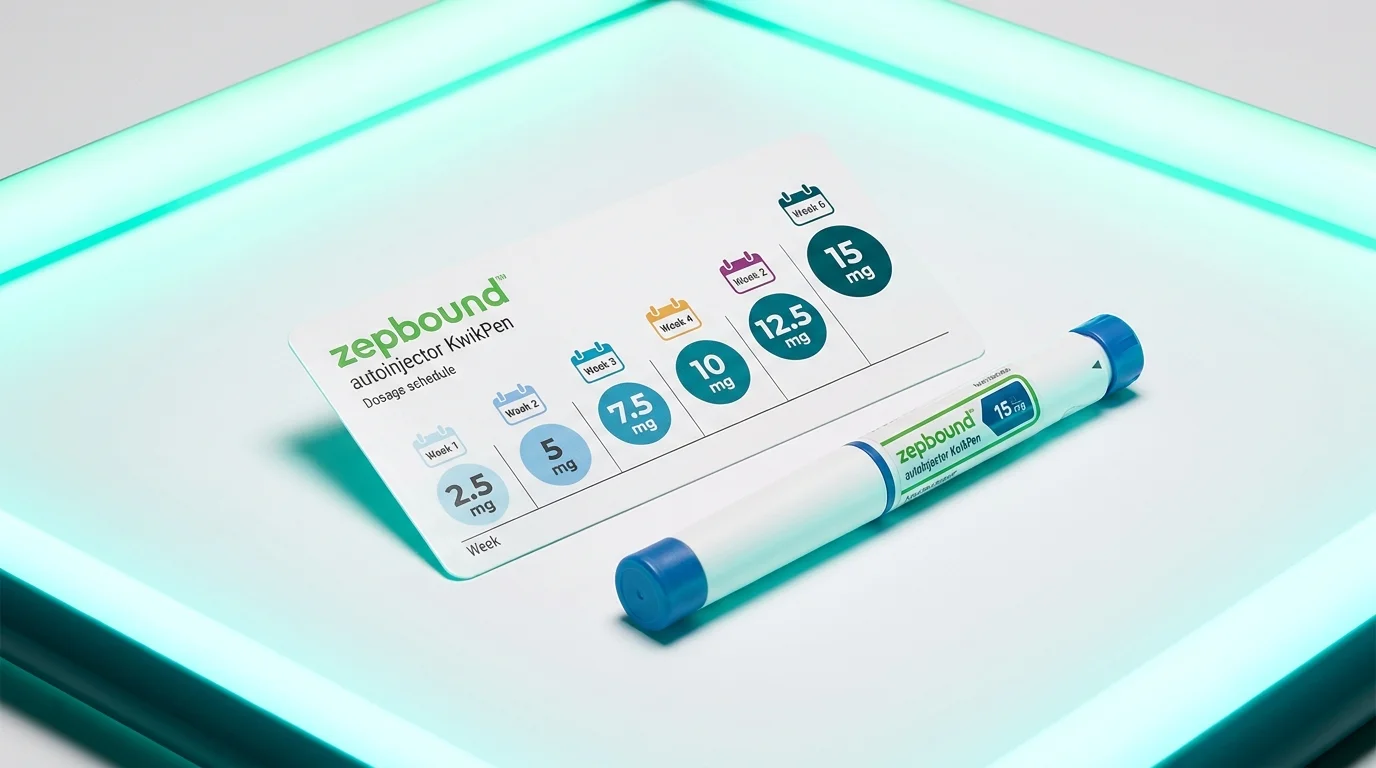
- Starting dose: 2.5 mg once weekly for 4 weeks. This dose is sub-therapeutic and builds GI tolerance before the first therapeutic dose of 5 mg begins at week 5.
- Titration pace: Increase every 4 weeks: 2.5 → 5 → 7.5 → 10 → 12.5 → 15 mg.
- Maintenance options: 5 mg, 10 mg, or 15 mg. Your prescriber decides based on weight loss response and tolerability.
- Time to maximum dose: approximately 20 weeks at the standard titration pace.
- Weight loss anchor: up to 20.9% mean body weight loss at 72 weeks on 15 mg (SURMOUNT-1, Jastreboff et al., NEJM 2022).
- Second indication: Zepbound also received FDA approval in December 2024 for moderate-to-severe obstructive sleep apnea in adults with obesity. The dosing schedule is the same.
The Zepbound dosage chart follows a six-step titration: starting at 2.5 mg once weekly and increasing every 4 weeks up to a maximum of 15 mg. Zepbound is the weight management brand of tirzepatide, FDA-approved in November 2023 for adults with obesity (BMI ≥ 30) or overweight (BMI ≥ 27) with at least one weight-related comorbidity. In SURMOUNT-1, the 15 mg dose produced a mean 20.9% body weight loss at 72 weeks.
This chart covers the Zepbound weight management indication. For T2D glycemic control dosing, see the Mounjaro dosage chart for T2D. For the molecular overview covering both brands, see the tirzepatide dosage chart.
What Is Zepbound and Who Is It For?
Zepbound is the weight management brand name for tirzepatide, a dual GLP-1 and GIP receptor agonist developed by Eli Lilly. The FDA approved Zepbound in November 2023 for chronic weight management as an adjunct to a reduced-calorie diet and increased physical activity. Eligible patients have a BMI of 30 or higher, or a BMI of 27 or higher with at least one weight-related comorbidity such as hypertension, dyslipidaemia, type 2 diabetes, or obstructive sleep apnea.
In December 2024, Zepbound received a second FDA approval for moderate-to-severe obstructive sleep apnea in adults with obesity. The dosing protocol for this indication is identical to the weight management schedule below.
The molecule works through two distinct pathways. GLP-1 receptor activation slows gastric emptying, suppresses appetite, and improves insulin sensitivity. GIP receptor activation adds a separate layer of appetite suppression and supports weight reduction. That dual action is why tirzepatide consistently outperforms GLP-1-only agents at comparable doses. The tirzepatide resource hub covers the full mechanism.
Zepbound vs Mounjaro: Same Molecule, Different Indication
Zepbound and Mounjaro contain identical tirzepatide. The same Eli Lilly manufacturing, the same 2.5 mg to 15 mg dose range, the same single-dose KwikPen autoinjector. The difference is the FDA indication and the clinical framing:
- Zepbound (approved November 2023): Indicated for chronic weight management. Primary endpoint: body weight reduction. Titration decisions are based on weight loss response and tolerability.
- Mounjaro (approved May 2022): Indicated for glycemic control in adults with type 2 diabetes. Primary endpoint: HbA1c reduction. Titration decisions are based on blood sugar response.
If your prescriber is managing T2D with tirzepatide, the Mounjaro dosage chart for T2D covers the glycemic framing in full.
Zepbound Dosage Chart: 2.5 mg to 15 mg Titration Schedule
Zepbound starts at 2.5 mg once weekly and increases by 2.5 mg every 4 weeks. The first dose is intentionally sub-therapeutic, built to establish gastrointestinal tolerance before any real weight loss begins. The first therapeutic dose is 5 mg at week 5. If you need more weight loss, your prescriber can keep escalating every 4 weeks up to the 15 mg maximum. Full ramp from start to the highest dose takes roughly 20 weeks.
Printable Zepbound Dosage Chart

Week-by-Week Titration Table
| Phase | Weeks | Dose | Purpose |
|---|---|---|---|
| Initiation | 1–4 | 2.5 mg | Sub-therapeutic. Establishes GI tolerance. |
| Escalation 1 | 5–8 | 5 mg | First therapeutic dose. Weight loss begins. |
| Escalation 2 | 9–12 | 7.5 mg | Intermediate step. Not a maintenance dose. |
| Escalation 3 | 13–16 | 10 mg | Common maintenance option. |
| Escalation 4 | 17–20 | 12.5 mg | Intermediate step. Not a maintenance dose. |
| Maximum | 21+ | 15 mg | Highest maintenance dose. Maximum weight loss. |
Source: Zepbound (tirzepatide) Prescribing Information, Eli Lilly and Company, 2024.
Important: 2.5 mg, 7.5 mg, and 12.5 mg are stepping-stone doses, not maintenance doses. The true maintenance options are 5 mg, 10 mg, and 15 mg. Your prescriber decides where to keep you based on your weight loss response and how well you tolerate each dose.
Weight Loss at Each Zepbound Dose: SURMOUNT-1 Data
SURMOUNT-1 (Jastreboff et al., N Engl J Med. 2022;387(3):205-216) enrolled 2,539 adults with obesity or overweight without type 2 diabetes and randomised them to tirzepatide or placebo for 72 weeks. It's the primary evidence base for the Zepbound weight management indication and the source for the dose-specific weight loss figures below (the side-effect table further down comes from the pooled Zepbound label table). Results in people with T2D and obesity are reported in SURMOUNT-2 and are also clinically meaningful, though typically somewhat lower.
2.5 mg (Weeks 1–4): Tolerance Phase
The 2.5 mg dose is intentionally sub-therapeutic. It does not produce meaningful weight loss and is not intended to. The goal is to let your GI system adjust before the first real dose begins. You may notice mild appetite suppression during these weeks, and that's normal. Getting through this phase without stopping is the only win worth tracking here.
5 mg (Weeks 5–8): First Therapeutic Dose
At 5 mg, tirzepatide reaches a clinically meaningful concentration. In SURMOUNT-1, the 5 mg group lost approximately 15% body weight at 72 weeks. A lot of people hit their weight loss goal at this dose and stay here long-term. Appetite suppression becomes noticeably stronger in this phase. GI side effects tend to peak in the first 1–2 weeks after the switch from 2.5 mg, then settle.
10 mg (Weeks 13–16): Most Common Target Dose
The 10 mg dose is where a lot of people land for the long term. In SURMOUNT-1, the 10 mg group lost approximately 19.5% body weight at 72 weeks. For a 250-pound person, that's about 49 pounds. If your weight loss goals are met and you're tolerating the dose well, many prescribers hold here rather than pushing to 15 mg.
15 mg (Weeks 21+): Maximum Dose
The 15 mg dose is the highest approved Zepbound dose and produced the greatest weight loss in SURMOUNT-1: 20.9% of body weight at 72 weeks. For a 250-pound person, that's roughly 52 pounds. Not everyone needs to reach 15 mg. The Zepbound label does not give a clean 5 mg vs 15 mg side-effect comparison, because its 5 mg column comes from SURMOUNT-1 only while the 15 mg column also includes adults with type 2 diabetes (SURMOUNT-2). Whether the extra weight loss at 15 mg is worth any added side effects is a conversation to have with your prescriber.
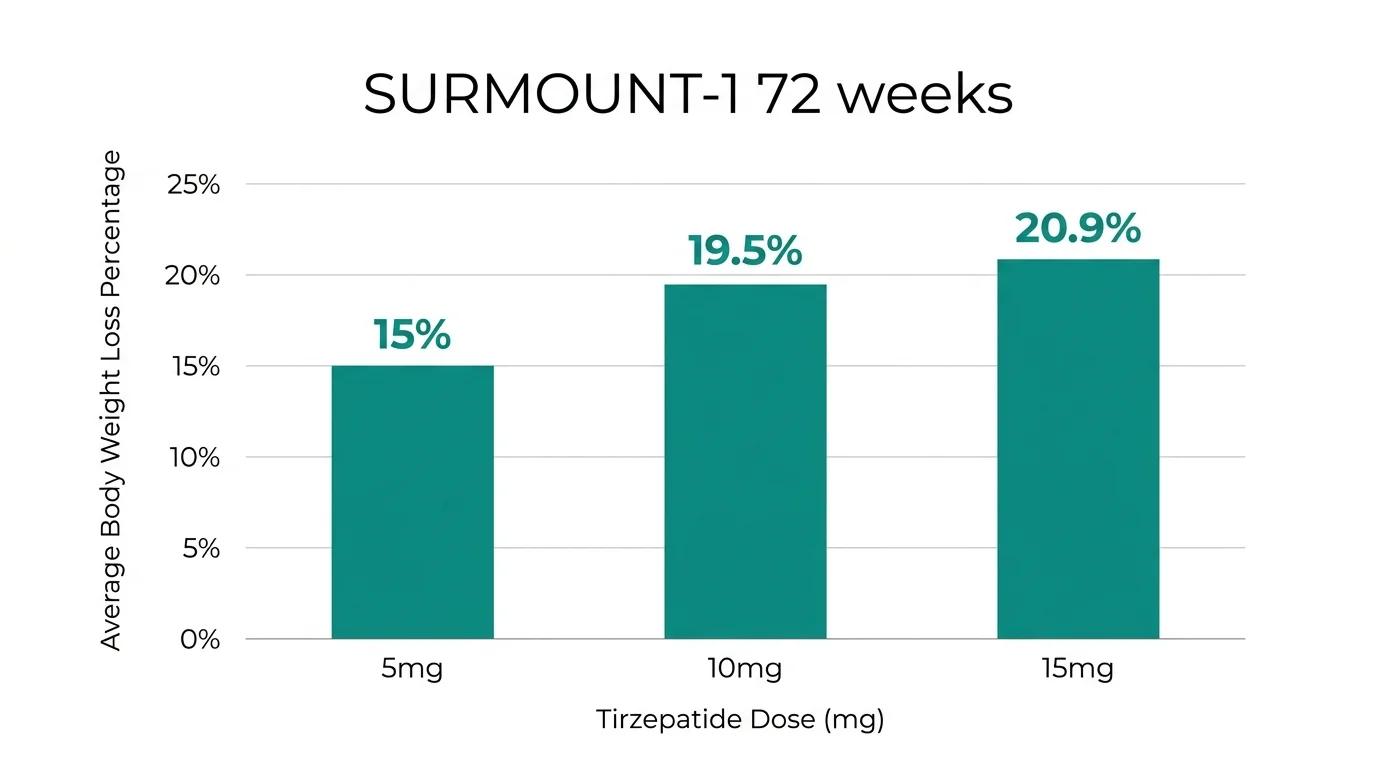
About SURMOUNT-1: This trial enrolled adults with obesity or overweight without type 2 diabetes, which is the primary Zepbound population. Results in people with T2D and obesity (SURMOUNT-2) are also clinically significant but are typically somewhat lower. All figures represent mean values from placebo-controlled trials, not guaranteed individual outcomes.
Side Effects by Dose Level
GI side effects with Zepbound hit hardest in the first 1–2 weeks after each escalation step. At a stable dose they usually settle within 2–4 weeks. The table below uses the Zepbound prescribing information, Table 1 (pooled SURMOUNT-1 and SURMOUNT-2, adults with obesity or overweight). The 5 mg column comes from SURMOUNT-1 only; the 10 mg and 15 mg columns also include SURMOUNT-2 (adults with type 2 diabetes), so the columns are not a clean dose comparison. For full management strategies, see the Zepbound side effects guide.
| Side Effect | 5 mg | 10 mg | 15 mg | Placebo |
|---|---|---|---|---|
| Nausea | 25% | 29% | 28% | 8% |
| Diarrhoea | 19% | 21% | 23% | 8% |
| Constipation | 17% | 14% | 11% | 5% |
| Vomiting | 8% | 11% | 13% | 2% |
| Abdominal pain | 9% | 9% | 10% | 5% |
Source: Zepbound prescribing information, Table 1 (pooled SURMOUNT-1 and SURMOUNT-2, adults with obesity or overweight).
Tip: If side effects are rough at a new dose, your prescriber can hold it for another 4 weeks before escalating. Rushing the titration pace doesn't improve outcomes. GI symptoms at a stable dose usually clear up within a few weeks.
Zepbound Autoinjector (KwikPen) Guide
Zepbound comes as a single-dose KwikPen prefilled autoinjector. There are six pen strengths, each color-coded to its dose: 2.5 mg, 5 mg, 7.5 mg, 10 mg, 12.5 mg, and 15 mg. Each pen contains one dose only. You can't draw a partial dose from a KwikPen and the pens can't be reused.
Injection Instructions
- Injection sites: Abdomen, thigh, or upper arm. Rotate sites weekly to avoid lipohypertrophy.
- Route: Subcutaneous injection only. Not for intravenous or intramuscular use.
- Day consistency: Inject once weekly on the same day each week. The day can be changed provided the gap between consecutive doses is at least 3 days (72 hours).
Storage
- Refrigerated: Store at 2°C to 8°C (36°F to 46°F) until the expiration date.
- Room temperature: Once removed from the refrigerator, a single pen may be kept at room temperature up to 30°C (86°F) for up to 21 days.
Source: Zepbound Prescribing Information, Eli Lilly and Company, 2024.
Using compounded tirzepatide? The same 2.5 mg to 15 mg titration schedule applies. With compounded vials you draw doses using an insulin syringe, which also allows custom increments. See the tirzepatide reconstitution guide for mixing instructions, and use the calculator to convert doses to syringe volumes.
Missed Dose Rules
The Zepbound prescribing information specifies the following missed-dose protocol:
- Fewer than 4 days (96 hours) since scheduled dose: Take the missed dose as soon as possible. Resume your regular weekly schedule.
- 4 or more days (96 hours or more) have passed: Skip the missed dose entirely. Resume your regular weekly schedule on the next scheduled injection day.
- Never take two doses within 4 days of each other.
- Multiple missed doses: Contact your prescriber. Depending on how long the gap was, your prescriber may restart titration at a lower dose to avoid rebound GI side effects.
Source: Zepbound (tirzepatide) Prescribing Information, Eli Lilly and Company, 2024.
Zepbound vs Wegovy: A Quick Dosing Comparison
Zepbound and Wegovy are the two FDA-approved injectable options for chronic weight management. Different molecules, different mechanisms. The table below covers the key dosing differences. For the full clinical comparison, see the tirzepatide vs semaglutide article.
| Zepbound (tirzepatide) | Wegovy (semaglutide) | |
|---|---|---|
| Mechanism | Dual GLP-1 + GIP | GLP-1 only |
| Starting dose | 2.5 mg | 0.25 mg |
| Maximum dose | 15 mg | 2.4 mg maintenance / 7.2 mg max |
| Titration steps | 6 levels (every 4 weeks) | 5 levels (every 4 weeks) |
| Time to max dose | ~20 weeks | ~16 weeks |
| Avg weight loss at max dose | 20.9% (SURMOUNT-1, 72 wks) | 14.9% (STEP 1, 68 wks) |
Note: SURMOUNT-1 and STEP 1 used different designs, populations, and durations. No head-to-head trial of Zepbound vs Wegovy has been published. See the full comparison for context.
How to Use This Zepbound Dosage Chart
- Find your current week: Count from the date of your first Zepbound injection and match it to the chart above.
- Confirm your pen strength: Cross-check that your KwikPen dose matches the expected dose for your week. If your prescriber has adjusted your pace, follow their instructions over this chart.
- Track your weight loss between appointments: Log your weight weekly. Bring readings to your next visit so your prescriber can assess your response before the next escalation decision.
- Prepare for each escalation: GI side effects typically peak in days 2–4 after each new dose. Eat smaller meals, avoid high-fat foods on injection day, and stay well hydrated.
- Visualise your drug levels: Use the Zepbound pharmacokinetic calculator to see how drug levels build and stabilise across your full titration schedule. Zepbound has a half-life of approximately 5 days and reaches steady state in about 4 weeks at each dose level (Zepbound label).
Visualise Your Zepbound Drug Levels
The free pharmacokinetic calculator shows peak and trough drug levels across your full Zepbound titration schedule, dose by dose through steady state. No account needed.
Open Zepbound Calculator →Zepbound Dosing Guide: A Prescribing Doctor Explains
Dr. Sasson from Lighthouse Weight Loss walks through the full titration arc from a prescriber's perspective: when to escalate, when to hold a dose, and what each Zepbound dose tier actually feels like in practice.
Frequently Asked Questions
What is the starting dose of Zepbound?
The starting dose of Zepbound is 2.5 mg once weekly for 4 weeks. This dose is intentionally sub-therapeutic and does not produce meaningful weight loss yet. It allows the body to adjust before the first therapeutic dose of 5 mg begins at week 5. Source: Zepbound Prescribing Information, Eli Lilly, 2024.
What are the Zepbound dose strengths?
Zepbound comes in six dose strengths: 2.5 mg, 5 mg, 7.5 mg, 10 mg, 12.5 mg, and 15 mg, each in a single-dose KwikPen autoinjector. Only 5 mg, 10 mg, and 15 mg are true maintenance doses. The other three are stepping-stone doses used during titration to reduce gastrointestinal side effects.
How much weight can you lose on each Zepbound dose?
In SURMOUNT-1 (72 weeks, n=2,539), participants lost approximately 15% body weight on 5 mg, 19.5% on 10 mg, and 20.9% on 15 mg. Individual results vary based on starting weight, adherence, diet, and activity. These are mean figures from a placebo-controlled trial, not guaranteed outcomes.
What is the highest dose of Zepbound?
The maximum approved dose of Zepbound is 15 mg once weekly. In SURMOUNT-1, the 15 mg dose produced 20.9% mean body weight loss at 72 weeks. Not every patient needs the highest dose; many achieve their weight loss goal at 5 mg or 10 mg. Your prescriber determines your maintenance dose.
What is the maintenance dose of Zepbound?
The FDA-approved maintenance doses for Zepbound are 5 mg, 10 mg, and 15 mg once weekly. Your prescriber selects based on your weight loss response and tolerability. In SURMOUNT-1, even the 5 mg dose produced approximately 15% body weight loss over 72 weeks, so many patients do well without reaching the maximum.
How long do you stay at each Zepbound dose before increasing?
Each Zepbound dose is held for a minimum of 4 weeks before increasing. If side effects are significant, your prescriber may extend the current dose for an additional 4 weeks. Full titration from 2.5 mg to the 15 mg maximum takes approximately 20 weeks when no delays occur. Source: Zepbound Prescribing Information.
What happens if I miss a Zepbound dose?
Per the Zepbound Prescribing Information: if fewer than 4 days (96 hours) have passed since the scheduled injection, take the missed dose as soon as possible. If 4 or more days have passed, skip the missed dose and resume your normal weekly schedule. Never take two doses within 4 days of each other. Contact your prescriber if you miss multiple doses.
Can I stay on a lower Zepbound dose instead of going to 15 mg?
Yes. Many patients achieve their weight loss goals at 5 mg or 10 mg without needing 15 mg. In SURMOUNT-1, the 5 mg group lost approximately 15% body weight over 72 weeks. Your prescriber will recommend where to stay based on your progress and tolerability. There is no clinical reason to rush to the maximum dose.
Is the Zepbound dosing schedule the same for compounded tirzepatide?
Yes. The 2.5 mg to 15 mg titration schedule applies equally to Zepbound KwikPens and compounded tirzepatide from 503A or 503B pharmacies. With compounded vials, doses are drawn with an insulin syringe, which also allows custom increments. Use the tirzepatide reconstitution guide for mixing instructions.
What is the difference between Zepbound and Mounjaro dosing?
There is no pharmacological difference. Zepbound and Mounjaro are identical tirzepatide from Eli Lilly with the same 2.5 mg to 15 mg dose range and the same 4-week titration pace. The distinction is FDA indication: Zepbound for weight management, Mounjaro for type 2 diabetes. See the Mounjaro dosage chart for T2D-specific clinical framing.
What is the Zepbound dosing schedule for obstructive sleep apnea?
Zepbound received a second FDA approval in December 2024 for moderate-to-severe obstructive sleep apnea in adults with obesity. The dosing schedule is identical to the weight management protocol: start at 2.5 mg once weekly for 4 weeks, then titrate every 4 weeks as tolerated to a maximum of 15 mg. Source: Zepbound Prescribing Information.
How does Zepbound compare to Wegovy for weight loss?
In separate trials, Zepbound 15 mg produced 20.9% mean weight loss at 72 weeks (SURMOUNT-1) versus Wegovy 2.4 mg at 14.9% at 68 weeks (STEP 1). No head-to-head trial has directly compared these two medications. The trials used different designs and populations; any comparison should be made cautiously. See the full tirzepatide vs semaglutide comparison for clinical context.
Track Your Zepbound Schedule
The free GLP3Planner calculator models your tirzepatide drug levels week by week, showing how levels build during titration and stabilise at steady state. No account needed.
References
- Eli Lilly and Company. Zepbound (tirzepatide) Prescribing Information. Rev. 2024. FDA Label (Lilly PI)
- Jastreboff AM, Aronne LJ, Ahmad NN, et al. Tirzepatide Once Weekly for the Treatment of Obesity (SURMOUNT-1). N Engl J Med. 2022;387(3):205-216. doi:10.1056/NEJMoa2206038. PubMed
- Garvey WT, Frias JP, Jastreboff AM, et al. Tirzepatide once weekly for the treatment of obesity in people with type 2 diabetes (SURMOUNT-2). Lancet. 2023;402(10402):613-626. doi:10.1016/S0140-6736(23)01200-X. PubMed
- Frías JP, Davies MJ, Rosenstock J, et al. Tirzepatide versus Semaglutide Once Weekly in Patients with Type 2 Diabetes (SURPASS-2). N Engl J Med. 2021;385(6):503-515. doi:10.1056/NEJMoa2107519. PubMed
- Wadden TA, Chao AM, Machineni S, et al. Tirzepatide after Intensive Lifestyle Intervention in Adults with Overweight or Obesity (SURMOUNT-3). Nat Med. 2023;29:2211-2219. doi:10.1038/s41591-023-02597-w. PubMed
Related Resources
Tirzepatide Hub
Complete tirzepatide resource: mechanism, dosing, side effects, clinical trials, and tools.
Tirzepatide Dosage Chart
The molecular dosage chart covering both Mounjaro and Zepbound with side-by-side brand data.
Mounjaro Dosage Chart (T2D)
Mounjaro dosing for type 2 diabetes with HbA1c outcomes from the SURPASS trial program.
Complete Tirzepatide Dosing Guide
In-depth dosing protocols, pharmacokinetics, and clinical trial summaries for tirzepatide.
Tirzepatide Side Effects
Common and rare Zepbound side effects with dose-by-dose breakdown and management strategies.
Microdosing Tirzepatide
Split-dose protocols for reducing GI side effects while maintaining therapeutic tirzepatide levels.
Tirzepatide Reconstitution Guide
Mixing compounded tirzepatide with BAC water and calculating insulin syringe volumes.
Medical Disclaimer: This dosage chart is for informational and reference purposes only. It does not constitute medical advice, diagnosis, or treatment. Dosing protocols may vary based on prescriber judgment, individual clinical response, comorbidities, and tolerability. Always follow your prescriber's instructions, which may differ from the standard titration schedule described here. If you experience serious side effects, contact your prescriber promptly.