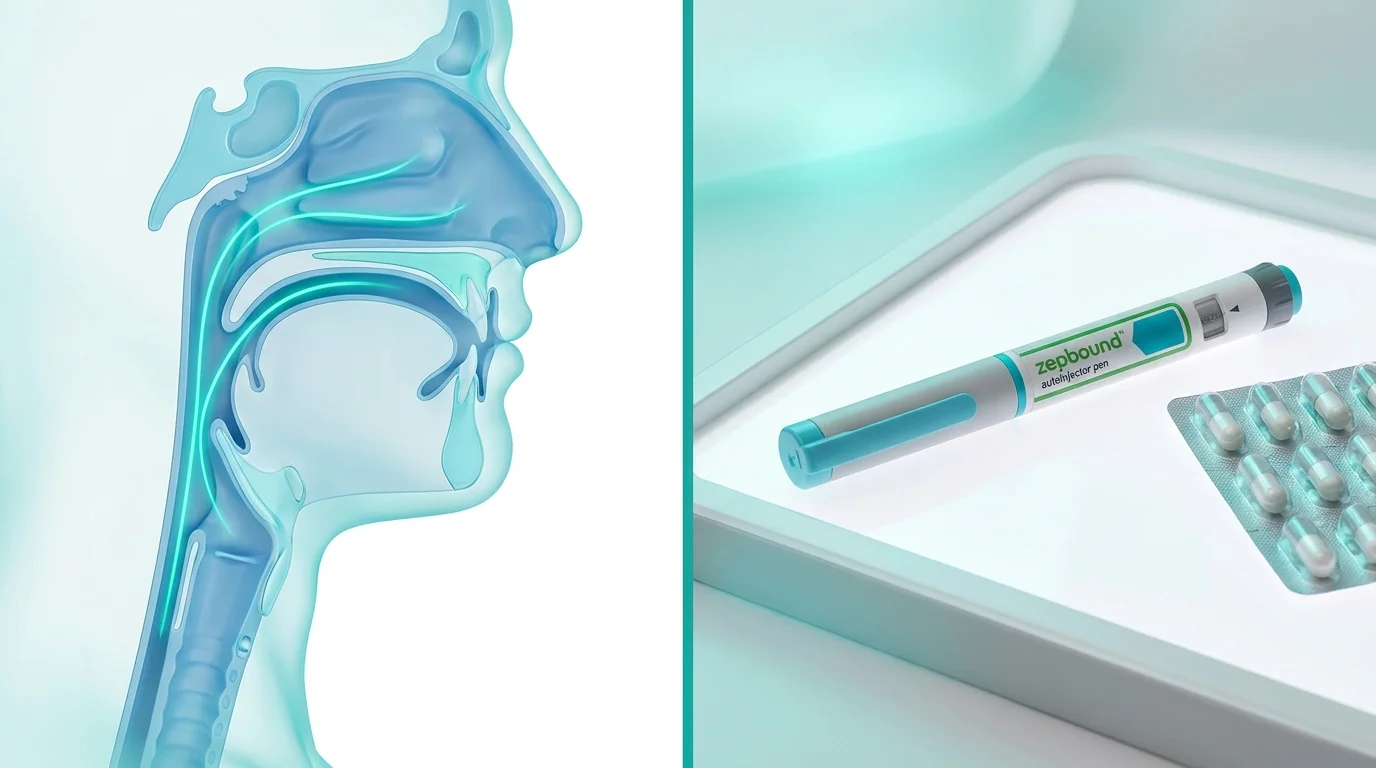
Tirzepatide Sleep Apnea Treatment: How Zepbound Treats OSA
Tirzepatide sleep apnea treatment became reality on December 20, 2024, when the FDA approved Zepbound (tirzepatide) for moderate-to-severe obstructive sleep apnea in adults with obesity, the first medication ever approved specifically for OSA. The drug does not target breathing directly; it works mostly by stripping fat off the upper airway through substantial weight loss, reopening the passage that collapses during sleep.
This page covers the mechanism, the exact SURMOUNT-OSA per-trial numbers, who qualifies under the FDA label, and how Zepbound fits alongside (not necessarily instead of) CPAP. Tirzepatide is FDA-approved, so this is established treatment, not an investigational protocol.
Key Takeaways
- First and only drug approved for OSA: the FDA approved Zepbound (tirzepatide) for moderate-to-severe OSA in adults with obesity on December 20, 2024
- Mechanism is weight-driven: it reduces parapharyngeal fat that loads the airway; participants lost 17.7% to 19.6% of body weight in the SURMOUNT-OSA arms
- SURMOUNT-OSA results: the apnea-hypopnea index fell by 25.3 events/hour (non-PAP) and 29.3 (PAP users), versus roughly 5 on placebo
- Remission was real but not universal: 42.2% and 50.2% of tirzepatide participants reached remission or mild disease, versus 14% to 16% on placebo
- Same molecule, different label: Zepbound carries the OSA indication; Mounjaro does not, and the brand affects insurance routing
- Not a guaranteed CPAP replacement: stopping CPAP is a clinical decision based on a follow-up sleep study, not an automatic result of the drug
What Is the Tirzepatide Sleep Apnea Approval?
Quick answer
Tirzepatide (Zepbound) is FDA-approved for moderate-to-severe obstructive sleep apnea in adults with obesity, the first medication ever approved for OSA. It works primarily by reducing upper-airway fat through significant weight loss (roughly 18% to 20% in the SURMOUNT-OSA trials), with possible additional airway effects still under investigation.
For decades, obstructive sleep apnea had no approved drug; the standard of care was a device, a mask, or surgery. The December 20, 2024 approval of Zepbound changed that with a weekly injection that addresses one of OSA's main reversible drivers, excess body weight, rather than just managing airflow during sleep. The approval rests on SURMOUNT-OSA, two Phase 3 trials reported by Malhotra and colleagues in the New England Journal of Medicine in 2024. The OSA indication sits on top of tirzepatide's existing approvals for type 2 diabetes (Mounjaro, 2022) and chronic weight management (Zepbound, 2023): the same molecule each time, just a different label.

Why this approval differs from the weight-loss indication
Mounjaro and Zepbound contain identical tirzepatide from Eli Lilly, but the OSA indication is written on the Zepbound label specifically. A prescription for OSA must be written for Zepbound, and that indication can change how an insurer routes coverage: per current CMS guidance, Medicare Part D cannot cover a medication prescribed purely for weight loss, but it may cover Zepbound prescribed for OSA. The drug is the same; the paperwork is not.
What Is Obstructive Sleep Apnea and Why Does Obesity Make It Worse?
Obstructive sleep apnea is a breathing disorder where the upper airway repeatedly narrows or collapses during sleep. Each collapse cuts off airflow, oxygen dips, and the brain rouses just enough to reopen the throat. People often do not remember these arousals, but they can happen dozens of times an hour, fragmenting sleep and straining the cardiovascular system. OSA affects a large share of adults worldwide and is heavily linked to obesity.
Severity is measured by the apnea-hypopnea index (AHI), the number of breathing interruptions per hour: under 5 is normal, 5 to 14 mild, 15 to 29 moderate, and 30 or more severe. The tirzepatide trials used a threshold of 15 or higher. Left untreated, that level of OSA is linked to high blood pressure, heart rhythm problems, and daytime sleepiness, which is why getting the index down matters beyond just sleeping better.
How obesity loads the upper airway
Excess weight does not just sit on the waist. Fat also deposits in the soft tissues around the throat, the parapharyngeal and peripharyngeal regions, and inside the tongue. These deposits crowd the airway and make it more likely to collapse when muscle tone drops during sleep, which is why neck circumference and BMI both predict OSA severity. Abdominal and chest fat add to the problem by reducing lung volume, letting the airway narrow more easily. This anatomy is the reason a weight-loss drug can treat a breathing disorder: tirzepatide is not a respiratory medication, it reduces the mechanical load on the airway by reducing the fat that loads it.
The treatment landscape before tirzepatide
Before December 2024, no drug was approved specifically for OSA. Continuous positive airway pressure (CPAP) was, and remains, the gold-standard therapy: a machine splints the airway open with pressurized air. CPAP works well when it is used, but long-term adherence is a known weak point, with many patients struggling to use it every night. Other options include oral appliances, positional therapy, and surgery. Tirzepatide adds a different kind of tool, one aimed at the underlying weight rather than the nightly airflow.
Track Your Zepbound Schedule
Use the free tirzepatide dosing calculator to visualize your titration and estimate drug levels between injections.
How Does Tirzepatide Treat Sleep Apnea?
Tirzepatide is a dual agonist: it activates both the GLP-1 and GIP receptors. That combination drives more weight loss than a GLP-1 drug alone, and weight loss is the engine behind its effect on sleep apnea. The honest version of the mechanism has two layers, one well-supported and one still being worked out.
Primary mechanism: weight-loss-driven airway decompression
The main pathway is straightforward. GLP-1 and GIP dual agonism reduces appetite and produces substantial weight loss; in the SURMOUNT-OSA arms, tirzepatide participants lost 17.7% and 19.6% of body weight, against 1.6% and 2.3% on placebo. As total body fat drops, so does the fat packed around the pharynx and inside the tongue, leaving a wider, more stable airway and fewer collapses per hour. Clinical guidelines have long noted that even modest weight loss improves sleep-disordered breathing, and both arms produced far more than modest weight loss, which helps explain why the AHI gains were so large.
The geography of the fat loss matters too. Pharyngeal fat concentrates in the lateral walls of the throat and within the tongue, both at the narrowest part of the airway, so when it shrinks the airway gains stability where it tends to collapse. Reductions in chest and abdominal fat help separately by restoring lung volume that tethers the airway open, so losing weight below the neck still improves breathing above it.
Secondary mechanism under investigation: direct airway effects
SURMOUNT-OSA went deeper than weight alone, with MRI substudies of airway and tongue fat and polysomnographic analysis of the traits that drive OSA: pharyngeal collapsibility, loop gain, muscle compensation, and arousal threshold. The investigators framed an open question directly: does tirzepatide help mostly by lowering BMI, or also through changes in upper-airway fat, loop gain, or inflammation?
The published mediation analyses cannot yet separate the weight-mediated effect from any direct drug effect on airway physiology. So the accurate statement is cautious: tirzepatide may also influence airway behavior beyond pure weight loss, but that has not been established. SURMOUNT-OSA's drop in hsCRP shows the drug moves an inflammatory marker, and weight loss can lower loop gain (a measure of overnight breathing instability), but moving a marker does not prove it caused the airway improvement. The careful framing here is possible additional effects, not confirmed mechanisms.
GLP-1 and GIP receptor biology in context
On the receptor side, GLP-1 activation reduces appetite and promotes satiety, while GIP activation contributes to energy balance and fat handling. Combining the two produces greater weight loss than GLP-1 agonism alone, and the airway benefit in OSA flows from that weight loss. The trials did not demonstrate a direct respiratory receptor mechanism, and this article does not claim one.
SURMOUNT-OSA Trial Results
SURMOUNT-OSA is the evidence base for the approval: two Phase 3 trials run by Malhotra and colleagues and reported together in the New England Journal of Medicine in 2024.

Trial design
Both trials were Phase 3, multicenter, randomized, double-blind, and placebo-controlled, enrolling 469 adults total over 52 weeks. Inclusion required moderate-to-severe OSA (AHI of 15 or more) and obesity (BMI of 30 or higher). Participants received the maximum tolerated dose of tirzepatide (10 mg or 15 mg) or placebo once weekly, titrated over the first 20 weeks then 32 weeks of maintenance, plus lifestyle intervention in both arms.
- Trial 1 (N=234): participants who were not using positive airway pressure (PAP) therapy at baseline
- Trial 2 (N=235): participants who were already on PAP therapy and stayed on it
Primary endpoint: AHI reduction
The primary endpoint was the change in apnea-hypopnea index at week 52, and both trials hit it with wide margins over placebo:
| Metric | Trial 1 (non-PAP) | Trial 2 (PAP users) |
|---|---|---|
| AHI change, tirzepatide | -25.3 events/hr | -29.3 events/hr |
| AHI change, placebo | -5.3 events/hr | -5.5 events/hr |
| Treatment difference | -20.0 (P<0.001) | -23.8 (P<0.001) |
These precise per-trial values are consistent with the rounded SURMOUNT-OSA data already cited on this site, which describes the AHI drop as roughly 25 to 29 events per hour across both arms.
Secondary endpoints: remission and weight
Remission or mild asymptomatic disease was defined as an AHI under 5, or 5 to 14 with an Epworth Sleepiness Scale score of 10 or below.
| Outcome | Trial 1 (non-PAP) | Trial 2 (PAP users) |
|---|---|---|
| Remission / mild disease, tirzepatide | 42.2% | 50.2% |
| Remission / mild disease, placebo | 15.9% | 14.3% |
| Body weight change, tirzepatide | -17.7% | -19.6% |
| Body weight change, placebo | -1.6% | -2.3% |
The trials also reported improvements beyond breathing: reductions in systolic blood pressure, lower hsCRP (an inflammatory marker), and better patient-reported sleep impairment scores. The caveat is that SURMOUNT-OSA ran for 52 weeks and was built to measure breathing and weight, not heart attacks or strokes over many years. It shows the markers moved; it does not, on its own, prove a long-term cardiovascular payoff.
Reading the numbers honestly: roughly four to five in ten tirzepatide participants reached remission or mild disease, a strong result, but that means roughly half did not. SURMOUNT-OSA showed a large average benefit, not a universal cure.
Who Qualifies for Zepbound for Sleep Apnea?
Eligibility for the OSA indication is narrower than for general weight management, and the difference trips people up.
FDA label criteria
- A formal OSA diagnosis: moderate-to-severe disease confirmed by a sleep study showing an AHI of 15 or more events per hour
- Obesity: a BMI of 30 or higher
- No comorbidity shortcut: unlike the weight-management indication, which allows a BMI of 27 or higher with a weight-related condition, the OSA indication does not include a lower-BMI pathway
- Adjunct to lifestyle: prescribed alongside a reduced-calorie diet and increased physical activity
A sleep study is the gatekeeper. There is no over-the-counter route, and a self-reported snoring problem is not enough; the diagnosis has to come from polysomnography or an approved home sleep test.
Same drug, different door
Tirzepatide for sleep apnea is not a different product than tirzepatide for weight loss; the molecule, strengths, and titration are identical. What differs is the door you walk through. The weight-management door needs a BMI of 30, or 27 with a weight-related condition; the OSA door needs a documented sleep study and a BMI of 30. That distinction matters for coverage, and for anyone with both obesity and confirmed moderate-to-severe OSA, the OSA indication can be the more durable route to insurance approval.
Dosing When Prescribed for Sleep Apnea
There is no separate OSA dose. Tirzepatide uses the same titration ladder whether it is prescribed for weight management or sleep apnea, because it is the same molecule at the same strengths.
Standard titration applies
Treatment starts at 2.5 mg once weekly and steps up every four weeks: 2.5 mg, then 5 mg, 7.5 mg, 10 mg, 12.5 mg, up to a maximum of 15 mg. The 2.5 mg starting dose is for tolerance, not effect. Tirzepatide has a half-life of about five days and is dosed once weekly, which is why increases are spaced four weeks apart, long enough for levels to settle. One nuance: SURMOUNT-OSA used the maximum tolerated dose of 10 mg or 15 mg, not a fixed endpoint, so not every participant climbed to 15 mg. Settle your target dose with your prescriber; the full protocol lives in the Zepbound dosing guide.
Plan the titration: the tirzepatide dosing calculator maps each weekly step and shows how drug levels build between injections, so you can see where you are in the schedule rather than guessing.
Watch: SURMOUNT-OSA Explained by NEJM
The New England Journal of Medicine published a short summary of the SURMOUNT-OSA trial covering its design, AHI endpoints, and patient population, a peer-review source rather than a product promotion.
What to Expect and How Long It Takes
Sleep apnea improvement tracks weight loss, and weight loss takes months to build, so realistic expectations matter more here than with most drugs.
Timeline of OSA improvement
Early weeks (4 to 8) usually bring modest weight loss while the dose is still low. More meaningful changes typically arrive between weeks 12 and 20 as the dose escalates. SURMOUNT-OSA measured its outcomes at week 52, and the large AHI improvements required that full duration. Expecting AHI to normalize in the first four weeks is unrealistic; the breathing benefit follows the weight, not the calendar of the first injection.
A sleep study repeated too early shows little, because the weight has not moved enough yet; one done after several months, once the dose is up and weight loss has accumulated, gives a far more useful picture. The goal is a sustained, tested reduction in the index, not a subjective sense that snoring has eased.
What happens to CPAP when on tirzepatide for OSA?
This is the most common question, and the answer is not "throw the machine away." In SURMOUNT-OSA Trial 2, participants on PAP therapy stayed on it throughout the study. Whether and when to stop CPAP depends on a follow-up sleep study showing the AHI has genuinely come down and stayed down. Only about 42% to 50% of trial participants reached remission, so it is not something to assume in advance.
A reasonable way to weigh the decision uses a few checkpoints: Has weight loss reached a plateau? Has a repeat sleep study confirmed the AHI is now in a safe range? Are symptoms like daytime sleepiness gone? And does the specialist agree the residual risk is low? CPAP and tirzepatide are not rivals; for many people the sensible sequence is to keep the machine while the weight comes off, then revisit it with fresh sleep data.
Do not stop CPAP on your own. Discontinuing airway pressure therapy without a repeat sleep study and your specialist's sign-off can leave untreated apnea hiding behind weight loss.
Safety and Side Effects in the Context of OSA
SURMOUNT-OSA did not turn up a new, OSA-specific safety problem. The side effect profile in the sleep apnea trials matched what tirzepatide shows everywhere else, so the considerations are familiar.
GI side effects remain the primary consideration
The most common side effects are gastrointestinal: nausea, diarrhea, constipation, and vomiting. They tend to be mild to moderate, show up most around dose-escalation steps, then settle as the body adapts, and slow titration is the main way to keep them manageable. For the full breakdown, see the Zepbound side effects guide. One OSA-specific point sits outside the side effect tables: sedating medications and evening alcohol can worsen airway collapse on their own, so the usual sleep-hygiene precautions still matter while OSA is being treated.
Contraindications
Boxed warning and contraindications: tirzepatide carries a boxed warning regarding thyroid C-cell tumors. It should not be used by people with a personal or family history of medullary thyroid carcinoma or multiple endocrine neoplasia syndrome type 2. Caution also applies with a history of pancreatitis or gallbladder disease. These are the standard Zepbound contraindications and are not specific to the OSA indication.
Frequently Asked Questions
Is tirzepatide (Zepbound) FDA approved for sleep apnea?
Yes. The FDA approved Zepbound (tirzepatide) for moderate-to-severe obstructive sleep apnea in adults with obesity on December 20, 2024, the first medication ever approved specifically for OSA. Mounjaro, the same molecule, does not carry the indication.
How does tirzepatide treat sleep apnea?
The main mechanism is weight loss that reduces upper-airway fat. In SURMOUNT-OSA, participants lost 17.7% to 19.6% of body weight, easing the load on the pharynx and tongue that drives airway collapse. Whether the receptors also affect airway tone directly is still under investigation.
What were the SURMOUNT-OSA results?
Across two 52-week Phase 3 trials totaling 469 adults, tirzepatide lowered the apnea-hypopnea index by 25.3 events per hour (non-PAP) and 29.3 (PAP users), versus about 5 for placebo. Between 42.2% and 50.2% of tirzepatide participants reached remission or mild disease, versus 14% to 16% on placebo.
Can tirzepatide replace CPAP?
Not automatically. SURMOUNT-OSA included CPAP users who stayed on therapy throughout, and only about 42% to 50% of tirzepatide participants reached remission. Any decision about stopping CPAP needs a sleep specialist and a repeat sleep study confirming sustained AHI improvement.
Does insurance cover Zepbound for sleep apnea?
It depends on the insurer and prescribed indication. Per current CMS guidance, Medicare Part D generally cannot cover weight-loss-only medications, but it may cover Zepbound prescribed specifically for OSA, while commercial plans vary widely. This is not insurance advice; check the specifics with your insurer and prescriber before assuming coverage.
Is Zepbound different from Mounjaro for sleep apnea?
The molecule is identical; both are tirzepatide from Eli Lilly. Zepbound holds the obesity and OSA indications, while Mounjaro holds only type 2 diabetes. For OSA treatment, the prescription must be written for Zepbound, and insurance routing and Medicare rules differ based on the brand on the script.
Does tirzepatide cure sleep apnea?
It can put OSA into remission for some people: 42% to 50% of SURMOUNT-OSA participants reached an AHI under 5 or mild asymptomatic disease, but that is not guaranteed and depends on continued treatment. If the drug is stopped and weight returns, apnea is expected to return. It addresses a reversible risk factor, not the underlying anatomy.
Plan Your Tirzepatide Schedule
Model your Zepbound titration and track dose levels between injections with the free tirzepatide tools.
References
- Malhotra A, Grunstein RR, Fietze I, et al.; SURMOUNT-OSA Investigators. Tirzepatide for the Treatment of Obstructive Sleep Apnea and Obesity. N Engl J Med. 2024;391(13):1193-1205. [PMC]
- U.S. Food and Drug Administration. FDA Approves First Medication for Obstructive Sleep Apnea. FDA News Release. December 20, 2024. [FDA.gov]
- Eli Lilly and Company. Zepbound (tirzepatide) Prescribing Information. FDA NDA 217806. Indianapolis: Eli Lilly; 2023. [FDA.gov]
- Jastreboff AM, Aronne LJ, Ahmad NN, et al. Tirzepatide Once Weekly for the Treatment of Obesity (SURMOUNT-1). N Engl J Med. 2022;387(3):205-216. [NEJM]
- American Academy of Sleep Medicine. Zepbound approved by FDA as first sleep apnea medication. AASM News. 2024. [AASM]
Medical Disclaimer
This article is for informational and educational purposes only and does not constitute medical advice. Do not start, stop, or change any medication, including tirzepatide or CPAP therapy, without consulting a qualified healthcare provider. Obstructive sleep apnea requires diagnosis and management by a clinician, and individual results vary. Always discuss treatment options, risks, and benefits with your doctor.
Related Tirzepatide Articles
Tirzepatide Hub
Complete resource center for the dual agonist.
Zepbound Dosing Guide
Full titration protocol from 2.5mg to 15mg.
How Tirzepatide Works
The dual GLP-1 and GIP agonist mechanism.
Zepbound Side Effects
What to expect and how to manage them.
Weight Loss Results
SURMOUNT-1 data and real-world outcomes.
FDA Approvals
Every Zepbound and Mounjaro indication.