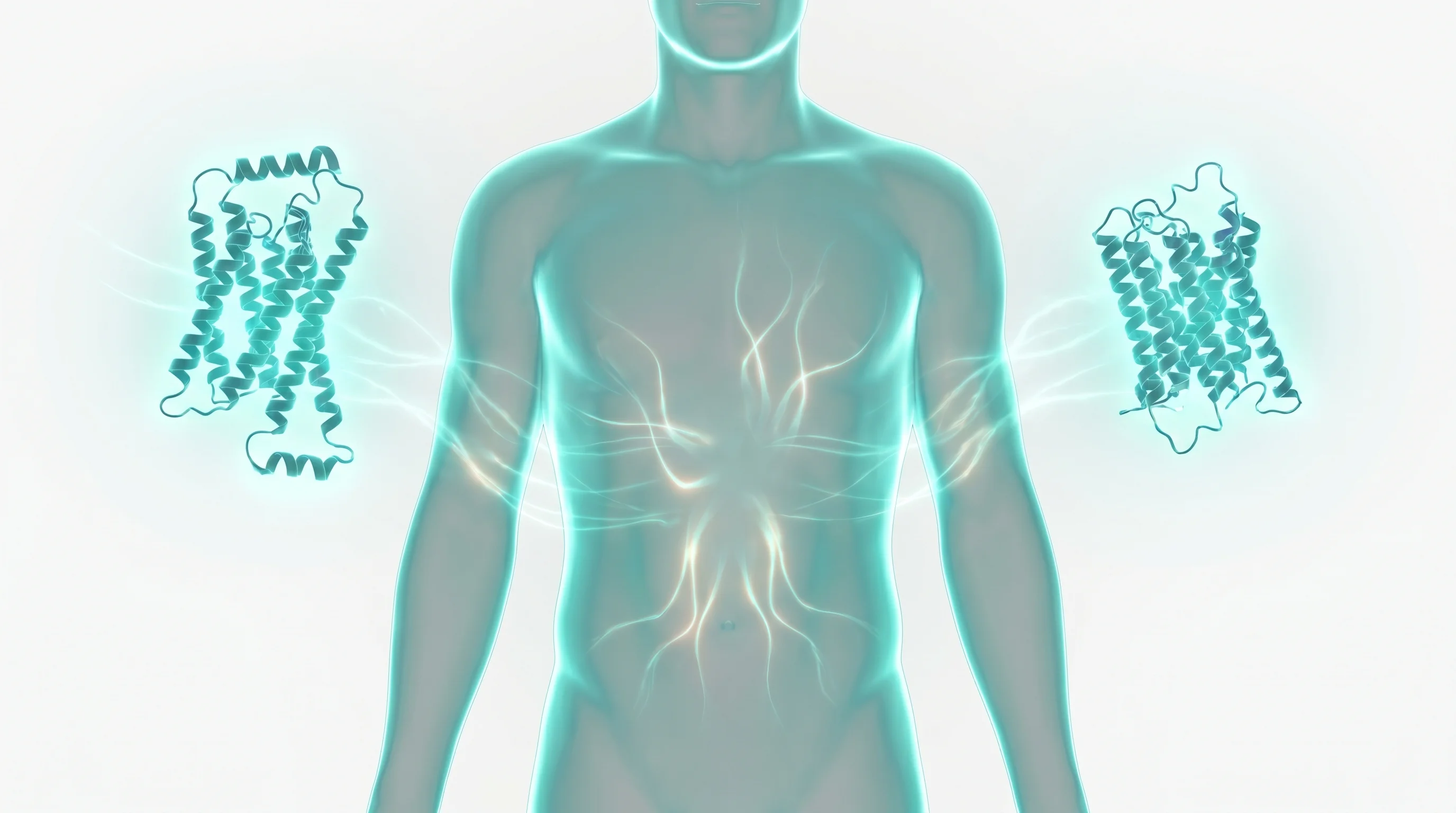
Dual-Agonist GLP-1 + GIP Medication
You have been prescribed Zepbound. Here is exactly what it does.
Zepbound contains tirzepatide, an FDA-approved dual agonist that activates two gut hormone receptors at once: GLP-1 and GIP. Together, those two pathways reduce hunger, slow digestion, and change how your fat cells store and release energy. This article explains each step in plain language, what the SURMOUNT-1 trial showed at 72 weeks, and why your dose takes four weeks to reach full effect.
Key Takeaways
- Zepbound is the weight-loss brand name for tirzepatide, approved by the FDA in November 2023 for chronic weight management in adults with obesity or overweight with a weight-related condition.
- It activates two hormone receptors at once (GLP-1 and GIP), making it a "dual agonist" -- a mechanism Wegovy and Ozempic do not use.
- Three main effects: appetite suppression, slowed gastric emptying, and improved insulin sensitivity plus direct fat metabolism effects via the GIP receptor.
- SURMOUNT-1 results at 72 weeks (15 mg): mean body weight loss of 20.9%; 57% of participants lost 20% or more of body weight.
- Half-life is approximately 5 days; full effect at each dose takes about 4 weeks -- use the Zepbound calculator to model when you will hit steady state.
2
Receptors Activated (GIP + GLP-1)
20.9%
Max Weight Loss (Trial, 72 weeks)
~5 days
Half-Life
2023 + 2024
FDA Approved (Obesity + OSA)
How does Zepbound work?
Zepbound works by activating two gut hormone receptors at the same time: the GLP-1 (glucagon-like peptide-1) receptor and the GIP (glucose-dependent insulinotropic polypeptide) receptor. GLP-1 receptor activation reduces appetite, triggers feelings of fullness, and slows how quickly food leaves your stomach. GIP receptor activation goes further, acting directly on fat tissue to improve insulin sensitivity and reduce visceral fat -- the metabolically harmful fat stored around your organs. Together, these two pathways reduce how much you eat and change how your body handles the energy you do consume.
What is a dual agonist, in plain English
Think of hormone receptors as locks on the surface of your cells. GLP-1 and GIP are keys your gut normally releases after a meal to signal "you have eaten, slow down." Semaglutide (Wegovy, Ozempic) carries only one key -- the GLP-1 key. Zepbound carries both keys simultaneously.
GLP-1 and GIP are both incretin hormones -- they are released from cells in the small intestine in response to food. Their normal job is to signal the pancreas to release insulin, tell the brain you are satisfied, and slow gastric emptying so nutrients are absorbed gradually. Zepbound mimics and amplifies both signals at once, which is why its effects on appetite and fat loss are stronger than medications targeting only one receptor.
For the full molecular pharmacology, including biased signaling and receptor affinity ratios, see our deeper look at how tirzepatide works at the receptor level. This article is the patient-friendly version; that one is for readers who want the biochemistry.
The three things Zepbound does in your body
Zepbound produces three distinct effects you will notice in your daily experience. Each one has a clear biological reason behind it.

Suppresses appetite -- you feel full faster
Both the GLP-1 and GIP receptors are active in the hypothalamus, the part of your brain that governs hunger and satiety. When Zepbound activates these receptors, it dials down ghrelin activity -- ghrelin being the hormone your stomach produces when it is empty to signal "time to eat." The result is that hunger signals arrive later, fade faster, and feel less urgent.
Meals become satisfying with significantly less food than before. This is not a willpower change. It's pharmacology resetting your hunger set-point. The same mechanisms that used to drive you to finish a plate now trigger satiety halfway through. Many people describe it as simply not being interested in finishing meals -- a different experience entirely from trying to resist hunger.
Slows gastric emptying -- food stays in your stomach longer
GLP-1 receptor activation reduces the rate at which food exits your stomach into the small intestine. This "delayed gastric emptying" extends the window of satiety after each meal and produces a flatter blood sugar curve after eating, because nutrients are released more gradually.
This mechanism also explains why nausea is the most common side effect during the first weeks on Zepbound. When a large or fatty meal meets a stomach that empties slowly, the pressure and delay can trigger nausea. The effect typically improves as your body adapts -- usually by weeks 3-4 at each dose level. See the full Zepbound side effects guide for management strategies.
Improves insulin sensitivity and directly affects fat tissue
This is where Zepbound separates itself from GLP-1-only medications. GIP receptors are found on fat cells (adipocytes), and when activated, they improve how those cells respond to insulin, take up glucose, and manage energy storage. Research by Gastaldelli et al. (2024) found that tirzepatide produces preferential reductions in visceral adipose tissue (VAT) -- the fat surrounding your organs that drives the most metabolic harm.
Only about 20% of the insulin sensitivity gains seen with tirzepatide are explained by weight loss itself. The GIP receptor appears to be acting directly on metabolic tissue, independent of the weight loss. This is not a stimulant-type "metabolism boost" -- it's a change in how your fat cells respond to insulin.
What Zepbound is approved to treat (and what it is not)
Zepbound has received two separate FDA approvals for two distinct indications. This is specific to Zepbound -- not all tirzepatide approvals cover both.
Chronic weight management (November 2023)
The FDA approved Zepbound in November 2023 for chronic weight management in adults. The eligibility criteria per the Zepbound prescribing information are:
- BMI of 30 or higher (defined as obesity), or
- BMI of 27 or higher (overweight) plus at least one weight-related condition: type 2 diabetes, hypertension, high cholesterol, obstructive sleep apnea, or cardiovascular disease
Zepbound is intended for use alongside reduced-calorie eating and increased physical activity, not as a standalone therapy.
Obstructive sleep apnea (December 2024)
In December 2024, the FDA approved Zepbound as the first drug ever approved for moderate-to-severe obstructive sleep apnea (OSA) in adults with obesity. This is a landmark: no medication had previously received this indication.
The mechanism for OSA is primarily through weight loss: reducing body fat in the neck, airway, and thorax decreases the anatomical obstruction that causes airways to collapse during sleep. Some research suggests GLP-1 and GIP receptors may also have direct effects on respiratory muscle function, though this is still under study. Source: FDA press release, December 20, 2024.
What Zepbound is NOT approved for
Important safety information
Zepbound is not approved for type 1 diabetes. It is not a substitute for insulin. It has not been studied in people under 18 years of age.
Boxed warning (thyroid C-cell tumors): Tirzepatide, like all GLP-1 receptor agonists, carries a class-effect boxed warning for thyroid C-cell tumors observed in rodent studies. The relevance to humans is not established, but Zepbound should not be used in patients with a personal or family history of medullary thyroid carcinoma or Multiple Endocrine Neoplasia syndrome type 2 (MEN 2). Source: Zepbound prescribing information.
What the clinical trials showed -- in numbers (SURMOUNT-1)
The primary evidence base for Zepbound's weight loss efficacy comes from the SURMOUNT-1 trial (Jastreboff et al., N Engl J Med, 2022). This was a 72-week randomized controlled trial in 2,539 adults with obesity or overweight plus at least one weight-related condition, without type 2 diabetes.
| Dose | Mean Weight Loss | Lost 5% or More | Lost 20% or More |
|---|---|---|---|
| 5 mg | -15.0% | 85% | 30% |
| 10 mg | -19.5% | 89% | 50% |
| 15 mg | -20.9% | 91% | 57% |
At the 15 mg dose, 91% of participants lost at least 5% of body weight -- a threshold widely used to define clinically meaningful weight loss. More than half (57%) lost 20% or more. To put that in concrete terms: a 250-pound person losing 20% would lose 50 pounds over 72 weeks.
For context, the STEP 1 trial for semaglutide 2.4 mg (Wegovy) showed a mean weight loss of 14.9% at 68 weeks. The caveat here is that these are different trial designs, different participant populations, and different durations -- they cannot be directly compared. For a structured head-to-head analysis, see our Zepbound vs Wegovy comparison.
How long Zepbound takes to work -- and why (pharmacokinetics)
The 5-day half-life, explained in plain English
A drug's half-life is how long it takes your body to clear half the amount in your system. Think of it this way: if you have 10 units in your blood and the half-life is 5 days, you have 5 units after 5 days, 2.5 units after 10 days, and so on. Tirzepatide has a half-life of approximately 5 days.
A 5-day half-life means once-weekly injections keep drug levels in your system at all times. Each new dose arrives before the previous dose has fully cleared, which is exactly what you want for continuous appetite suppression throughout the week.

Why 4 weeks between dose increases
It takes approximately 4 to 5 half-lives to reach steady-state drug levels -- the point where the amount entering your system each week equals the amount your body clears. With a 5-day half-life, that means 20 to 25 days to reach steady state at any given dose.
This is the pharmacokinetic reason behind the standard Zepbound titration schedule:
Standard titration: 2.5 mg every 4 weeks
2.5 mg (4 wks) → 5 mg (4 wks) → 7.5 mg (4 wks) → 10 mg (4 wks) → 12.5 mg (4 wks) → 15 mg
Appetite reduction begins within the first few days of injection. But you are not experiencing the full effect of your current dose until week 4, when steady-state levels are reached. If a dose step-up happens before steady state, you may be adding dose before you have felt the full benefit of what you already have.
The 2.5 mg starting dose is designed for tolerability, not efficacy. Most prescribers will titrate upward every 4 weeks as tolerated to reach the dose where weight loss becomes clinically meaningful for your individual metabolism and goals.
See exactly when you will hit steady state
The Zepbound calculator uses exponential decay modeling to show how tirzepatide builds in your system at each dose step -- so you can visualize your pharmacokinetics, not just read about them.
Open the Zepbound CalculatorZepbound vs Wegovy -- what the mechanism difference means for you
Wegovy and Ozempic contain semaglutide, which activates only the GLP-1 receptor. Zepbound adds the GIP receptor on top. GIP receptors are distributed throughout fat tissue and the brain in a different pattern than GLP-1 receptors -- the two pathways work on different targets, so the effects add up rather than overlap.
The GIP component accounts for much of the additional fat loss beyond what GLP-1 alone achieves. In a real-world study, Rodriguez et al. (JAMA Internal Medicine, 2024) found tirzepatide users lost 6.9% more body weight than semaglutide users at 12 months. That gap outside a controlled trial setting suggests the dual mechanism produces real differences, not just trial-condition ones.
Both medications still work primarily through appetite suppression. Individual response varies. Some people do better on one than the other based on tolerability, the dose they can reach, insurance coverage, and injection-type preference. For a full breakdown covering mechanism, dosing, side effects, cost, and trial data, see our Zepbound vs Wegovy comparison.
Quick reference: Semaglutide = 1 receptor (GLP-1). Tirzepatide (Zepbound) = 2 receptors (GLP-1 + GIP). The GIP addition is why tirzepatide produces greater average fat loss across clinical and real-world data, with the difference most pronounced in visceral fat reduction.
Video: How Zepbound (Tirzepatide) Compares to Wegovy
Dr. Christopher McGowan, a board-certified gastroenterologist and bariatric endoscopist, explains the dual-agonist mechanism and what it means compared to semaglutide. This is a 5-minute clinical overview, not a product promotion.
Frequently Asked Questions
How exactly does Zepbound make you lose weight?
Zepbound activates two gut hormone receptors at once: GLP-1 and GIP. GLP-1 receptor activation reduces appetite and slows gastric emptying, making meals feel more satisfying with less food. GIP receptor activation acts directly on fat tissue, improving insulin sensitivity and preferentially reducing visceral fat around your organs. In SURMOUNT-1, the 15 mg dose produced a mean 20.9% body weight loss at 72 weeks.
How long does Zepbound take to work?
Appetite suppression begins within the first few days of injection. Meaningful weight loss typically appears after 4-8 weeks. Because Zepbound has a half-life of approximately 5 days, it takes roughly 4 weeks to reach steady-state levels at each dose -- which is why dose increases are spaced 4 weeks apart. Full therapeutic effect at the maintenance dose builds over several months of titration.
How does Zepbound work differently from Ozempic or Wegovy?
Ozempic and Wegovy (semaglutide) activate only the GLP-1 receptor. Zepbound activates both GLP-1 and GIP receptors. The GIP component adds direct effects on fat tissue metabolism that semaglutide cannot achieve. In a real-world study (Rodriguez et al., JAMA Internal Medicine, 2024), tirzepatide users achieved 6.9% greater weight loss than semaglutide users at 12 months.
Do I need to stay on Zepbound forever?
Zepbound treats obesity as a chronic condition. Clinical evidence shows significant weight regain after stopping tirzepatide because the appetite and metabolic effects stop when the drug does. Your prescriber will discuss long-term management -- maintenance dosing, lifestyle changes, or both -- based on your individual goals.
How does Zepbound work for sleep apnea?
Zepbound received FDA approval for moderate-to-severe obstructive sleep apnea in adults with obesity in December 2024 -- the first drug approved for this indication. Its primary mechanism in OSA is through weight loss: reducing body fat in the neck, airway, and thorax decreases upper-airway obstruction during sleep. Direct GLP-1 and GIP effects on respiratory muscles may also play a role, though this is still being studied.
Can you stay on 2.5 mg Zepbound and lose weight?
Some weight loss occurs at 2.5 mg, but that dose is designed for tolerability during the first four weeks rather than maximum efficacy. SURMOUNT-1 showed progressively greater weight loss at higher doses: 15.0% mean at 5 mg, 19.5% at 10 mg, and 20.9% at 15 mg. Most prescribers titrate upward every 4 weeks as tolerated to find the dose where weight loss becomes clinically meaningful for you.
The bottom line
Zepbound activates two hormone receptors at once -- GLP-1 reduces appetite and slows gastric emptying, while GIP acts directly on fat tissue to change how your body processes and stores energy. The combined effect is stronger than either receptor alone, which is why the clinical results separate from GLP-1-only medications.
The clinical evidence from SURMOUNT-1 showed a mean 20.9% body weight loss at 72 weeks for the 15 mg dose, with 57% of participants losing 20% or more. Those numbers take time. Zepbound's 5-day half-life means full effect at each dose takes about 4 weeks to arrive, and the full titration from 2.5 mg to 15 mg spans roughly five to six months.
The Zepbound pharmacokinetic calculator shows exactly how drug levels build at each dose step in your specific schedule -- so the timeline isn't abstract. It's your timeline.
Model Your Zepbound Journey
Visualize how tirzepatide builds in your system at each dose step. Free pharmacokinetic calculator, no account required.
References
- Jastreboff AM, Aronne LJ, Ahmad NN, et al. Tirzepatide Once Weekly for the Treatment of Obesity (SURMOUNT-1). N Engl J Med. 2022;387(3):205-216. DOI: 10.1056/NEJMoa2206038. [PubMed]
- Zepbound (tirzepatide) Prescribing Information. Eli Lilly and Company. FDA label, approved November 2023. [FDA.gov]
- FDA. FDA Approves First Medication for Obstructive Sleep Apnea. FDA.gov. December 20, 2024. [FDA.gov]
- Coskun T, Sloop KW, Loghin C, et al. LY3298176, a novel dual GIP and GLP-1 receptor agonist for the treatment of type 2 diabetes mellitus. Mol Metab. 2018;18:3-14. DOI: 10.1016/j.molmet.2018.09.009. [PubMed]
- Gastaldelli A, et al. Tirzepatide in Adipose Tissue and Metabolism: A 2024 Review. PMC. 2024. [PMC]
- Rodriguez PJ, Goodwin Cartwright BM, Gratzl S, et al. Semaglutide vs Tirzepatide for Weight Loss in Adults With Overweight or Obesity. JAMA Intern Med. 2024;184(9):1056-1064. DOI: 10.1001/jamainternmed.2024.2525. [JAMA]
Medical Disclaimer
This article is for informational and educational purposes only and does not constitute medical advice. Zepbound (tirzepatide) is an FDA-approved prescription medication. Do not start, stop, or modify any medication regimen without consulting a qualified healthcare provider. Individual results vary significantly and cannot be predicted based on clinical trial averages. Always discuss treatment options, risks, benefits, and alternatives with your prescribing physician.
Related Zepbound and Tirzepatide Articles
Tirzepatide Hub
Complete resource center for Zepbound and Mounjaro.
Zepbound Dosing Guide
Full titration protocol from 2.5 mg to 15 mg with schedules.
Zepbound Side Effects
What to expect and how to manage nausea, GI effects, and more.
Microdosing Zepbound
Split-dose strategies for improved tolerability.
Zepbound Weight Loss Results
Clinical trial data, timelines, and what to realistically expect.